
Understand · what it is and why it exists
01What it is
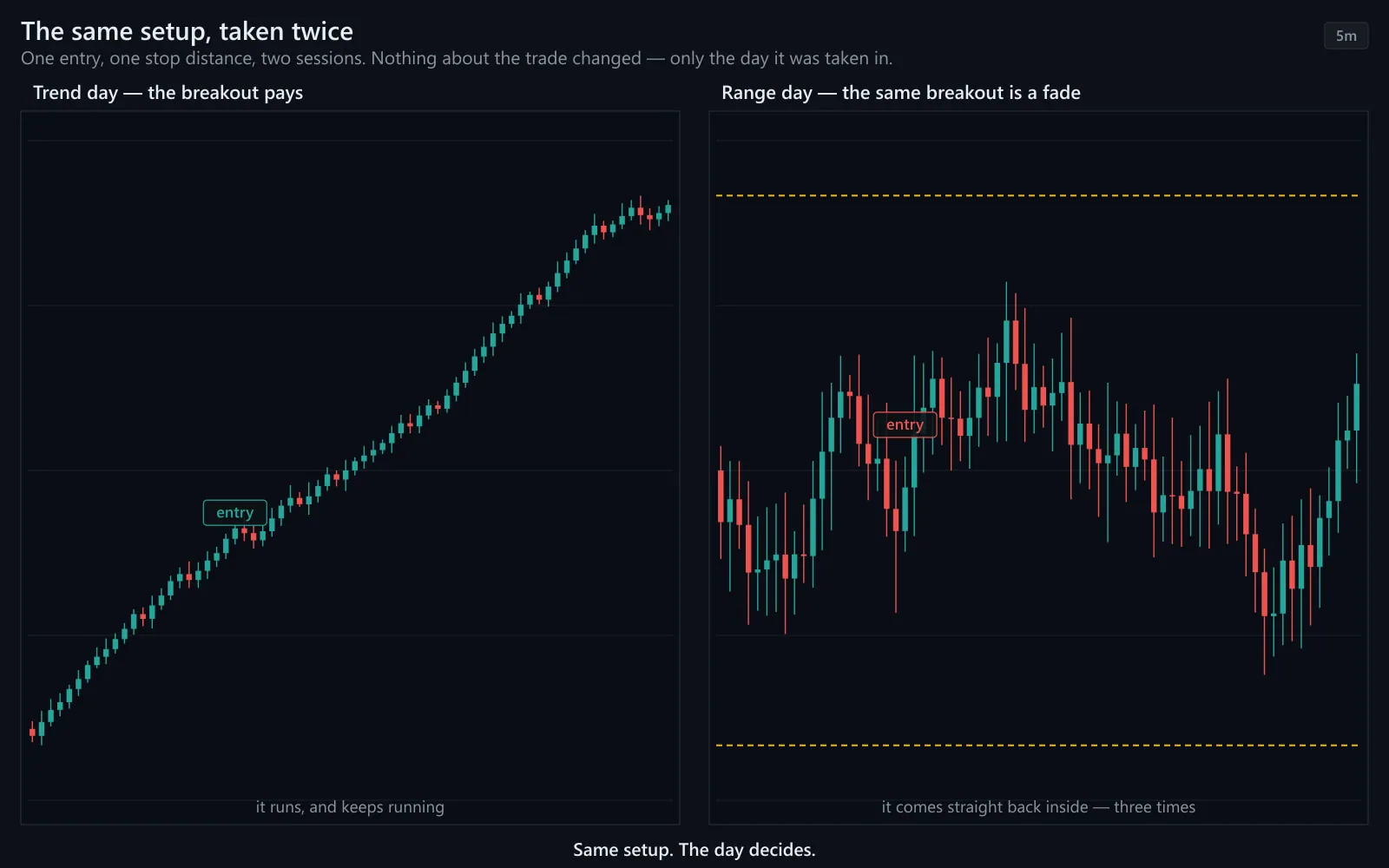
Strategy changing with condition means that the trade you look for depends on the kind of session you are in. On a trend day traders often look for continuation: pullbacks that hold, shallow dips, a close near the extreme. On a range day they often look for mean reversion: reactions at the edges, a drift back toward the middle, breakouts that tend to fail.
A trend approach on a range day tends to get chopped — stopped out on failed breaks. A range approach on a trend day tends to get run over — fading a move that does not come back. Neither approach is wrong in itself; each is mismatched on the other kind of day.
02Why it exists
The mismatch cost exists because the two kinds of day are produced by opposite conditions — an imbalance versus a balance — and a strategy is a bet on one of them. A breakout is a bet that an imbalance will carry price away; a fade is a bet that balance will pull it back. Betting on an imbalance when there is none, or on balance when one side is in control, starts from the wrong premise.
03How it is measured or observed
The practical version is a short checklist before any setup is considered:
- Label firstFrom the opening clues, VWAP, breadth, volume and pullback depth: trend, range, or unclear.
- Strategy secondTrend → the class considers continuation setups only (pullbacks, breakouts with volume). Range → mean-reversion setups only (edge reactions, failed-breakout reversals).
- Size thirdClear label, the planned size stands. Unclear label, reduced size — or no trade.
- Re-label on evidenceLost VWAP after holding all morning, breadth narrowing to even, the first failed break: the label has changed and so has the strategy.
Read · seeing it in the market
04How professionals read it
Professionals think of the session as an environment and the setup as something that only exists inside the right one. A perfect-looking breakout on a range day is often the day's trap, however clean the pattern. A pullback to VWAP on a trend day can qualify as a setup, even when it feels like buying high. The environment shapes what is worth considering.
They keep the label explicit. It is written on the plan — 'trend up, continuation only' — and it is revised out loud when the evidence changes. The most expensive mistakes come from a label held out of pride after the day has moved on.
And they accept 'unclear' as an answer. Three trend clues and two range clues is not a 60/40 trend; it is a session with no clear environment, and the usual response is small size or none. No valid setup, no trade — and the setup cannot be valid if the environment is unknown.
05What strength looks like
Approach matched to condition, as an illustration: on a trend day, pullbacks toward VWAP studied as continuation entries, each with a stop below the line. The approach fits the day; that does not make any single trade work.
Illustrative. Pullbacks (annotated) toward VWAP (gold) on a trend day that closes near its high. Not a record of trades.
Source: illustrative teaching data — not market data
06What weakness looks like
Approach mismatched: a breakout approach on a range day. Every break looks like the one that will hold; many re-enter the range, and the stops are hit. The trades were not bad trades — they were trend trades taken in a range.
Approach fits the condition
- Breakouts studied on a trend day
- Fades studied on a range day
Approach fights the condition
- Breakouts attempted on a range day
- Fades attempted on a trend day
A teaching description of fit — not a performance record and not a statistic.
Interpret · what it means for you
07What it means for an investor
For an investor the lesson is mostly about patience and order type: the condition of the day decides whether a market order at the open is harmless or costly, and a limit order placed once the day has declared itself is one common way investors handle it. A long-term plan does not change with the day.
08What it means for a trader
For a trader this is the whole of the Advanced program in one sentence: a trade begins before Buy, with the label of the day. The class sequence: find the stocks in play, read the environment, recognise the setup that fits it, plan entry, stop, size and target, execute only if valid, adapt when the label changes, review after. Much of the discipline the Advanced program practises is declining to run an approach the day's condition does not support.
09What it cannot tell you
- The label is a working estimate, not a forecast; days change character.
- A clear label does not make any individual setup valid — the rest of the checklist still applies.
- Counting clues is not a formula; 'unclear' is a legitimate and frequent answer.
Apply · the market right now
10What is happening right now
MAAL TRADING ACADEMY market note
No dated note has been published for this topic yet. We only publish current-market commentary written and dated by the academy — nothing auto-generated.
Data · previous close
Live levels for SPY, QQQ appear here once the licensed market-data feed is connected. We do not show unlicensed or made-up numbers.
How to check this yourself today
- Write today's label for SPY in one line: trend, range, or unclear — and the three clues behind it.
- List which setups that label permits and which it forbids.
- Check whether any evidence since the first hour has changed the label.
- For yesterday, write down which label you would have given at 10:30 and whether it held into the close.
11Visual market example
The full checklist, side by side. Every row is an observation you can make; every row leans one way or the other; the column that fills up is the label, and the label decides the strategy. That is the order of operations — condition, then strategy, then setup, then size.
Trend day
- Gap holds; opening range left and not revisited
- One side of VWAP; pullbacks to it hold
- Breadth one-sided and widening
- Volume expands with the move
- Close near the extreme
Range day
- Gap fills; opening range broken then re-entered
- VWAP crossed again and again
- Breadth flips sign
- Volume spikes at the edges, dies in the middle
- Close near the middle; breakouts fail
The same five clues, read on each kind of session.
Review · practise, keep, connect
12Test your understanding
Read the chart the way you would before a trade. Pick the answer, then read why.
1By 10:30 the gap held, the opening range broke and extended, VWAP has been held twice, and breadth is 4:1 and widening. A clean breakout in a stock in play appears at 11:00. Is the breakout strategy appropriate?
Illustrative.
Source: illustrative teaching data — not market data
2Same clues, but breadth is 1.2:1 and VWAP has been crossed three times. What is the label and the size?
Illustrative.
Source: illustrative teaching data — not market data
13Key takeaways
- Traders tend to study continuation on trend days and mean reversion on range days. The same idea can fit one and not the other.
- Label first, strategy second, setup third, size last.
- 'Unclear' is a real label; it means smaller size or no trade.
- Re-label out loud when the evidence changes — the expensive mistake is pride in a stale label.
15Learn it in class
Advanced Program · Stage 7 · Trading the Closing Bell
Advanced: the live final hour, where only qualifying simulated setups are taken — and 'qualifying' starts with the label of the day.